Physical Address
304 North Cardinal St.
Dorchester Center, MA 02124
Physical Address
304 North Cardinal St.
Dorchester Center, MA 02124

Last summer, I walked into my basement and the air hit me like a wet blanket. Not musty yet, but that damp heaviness that tells you mold is making up its mind. I had been running a portable dehumidifier — a 50-pint unit that emptied itself twice a day and still left the humidity hovering around 65%. The basement is finished, about 1,800 square feet, and I use it as a workshop and home gym. The portable unit worked hard, but it was losing the war. That is when I started looking seriously at whole-house dehumidifiers, and specifically at the AprilAire E100W review category, because I needed something that could actually keep up. What follows is my honest account after several months of running the AprilAire E100W Smart Wi-Fi Whole-House Dehumidifier in that same basement — without the portable unit as backup.
Disclosure: Some links in this article are affiliate links. We may earn a commission if you buy through them. This does not influence our findings or recommendations.
For a different take on managing indoor air, you might also check my Mitsubishi 18k BTU mini-split review — another approach to comfort control. And if you are already fairly sure the AprilAire is what you need, you can see the current bundle price here.
The short answer on AprilAire E100W Smart Wi-Fi Whole-House Dehumidifier
| Tested for | Three months in a finished basement workshop and gym (1,800 sq ft) plus adjacent crawl space, summer and early fall in the Mid-Atlantic region. |
| Best suited to | Homeowners with a basement, crawl space, or sealed attic over 2,000 sq ft who want set-it-and-forget-it humidity control and are comfortable with a more involved install than a portable unit. |
| Not suited to | Anyone who needs a simple, plug-and-play dehumidifier for a single room under 1,500 sq ft — a portable unit will be cheaper and easier. |
| Price at review | $2,185.98 |
| Would I buy it again | Yes, but I would not recommend it to everyone. If you have the space, the need, and the willingness to do a proper installation, it is the most effective residential dehumidifier I have used. For a quick fix in a small room, it is overkill. |
Full reasoning below. Or check the current price here if you have already decided.
The AprilAire E100W is a whole-house dehumidifier, not a portable unit you roll from room to room. It is designed to be installed in a basement, crawl space, or mechanical room and connected either to a standalone drain or your existing HVAC ductwork. It pulls 100 pints of moisture per day and is rated for spaces up to 5,500 square feet under ideal conditions — though in practice, I would call it a solid choice for homes in the 2,500 to 4,000 square foot range if you want consistent results.
It is not a portable dehumidifier. It does not have casters. It is not something you will move around the house. It weighs 64 pounds and is meant to stay put. It is also not a cheap fix — this is a premium product from a well-known brand in the HVAC and indoor air quality space. AprilAire (owned by Research Products Corporation) has been making whole-house humidity control products for decades, and the E100W sits near the top of their residential line. If you are used to buying $250 portables from a big-box store, the price tag on this thing will make you pause.
In terms of market position, this is a premium whole-house unit. It competes directly with units from Santa Fe, AlorAir, and Honeywell’s higher-end offerings. It is not entry-level — you are paying for build quality, smart features, and a serious warranty. Whether that translates into value for you depends on how bad your humidity problem actually is.
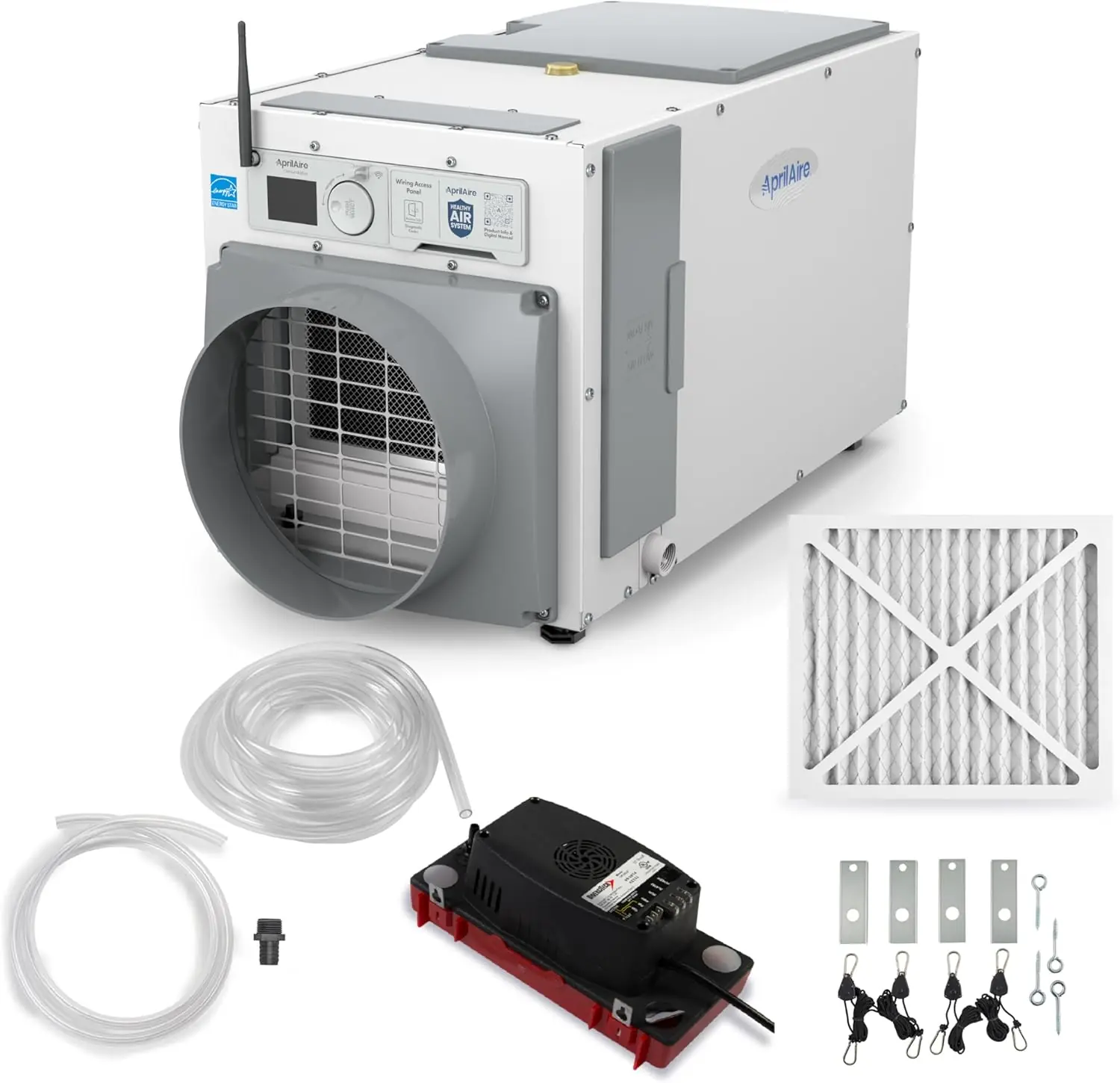
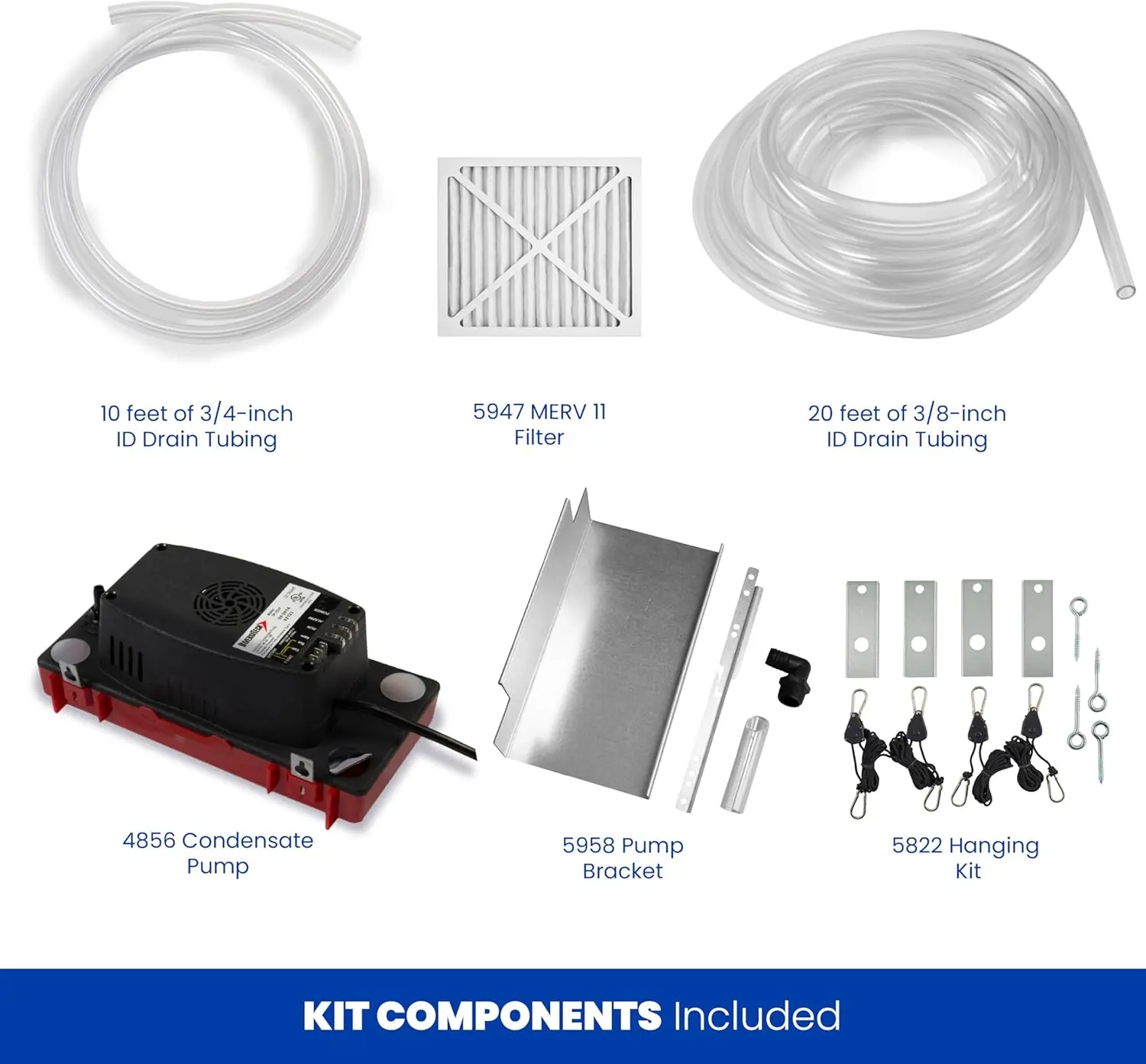
The box is large and heavy — about 70 pounds total with all the components. AprilAire ships it as a bundle, which means you get more than just the dehumidifier unit itself. Inside I found:
Packaging was functional — heavy double-wall corrugated cardboard with foam end caps. Nothing premium about the unboxing experience, but nothing damaged either. The unit itself has a solid, industrial feel. The housing is powder-coated sheet metal, and the control panel is a simple digital display with membrane buttons. It does not feel like a consumer appliance. It feels like HVAC equipment, which is appropriate given the price point.
One thing I noticed immediately: there is no power cord long enough to reach everywhere. The included cord is about 8 feet, so plan your outlet placement or have an extension cord ready (a heavy-duty one — this unit draws 828 watts at full load). Also, you will need a drain solution. The pump and tubing are included, which is good, but you still need somewhere to send the water. More on that below.
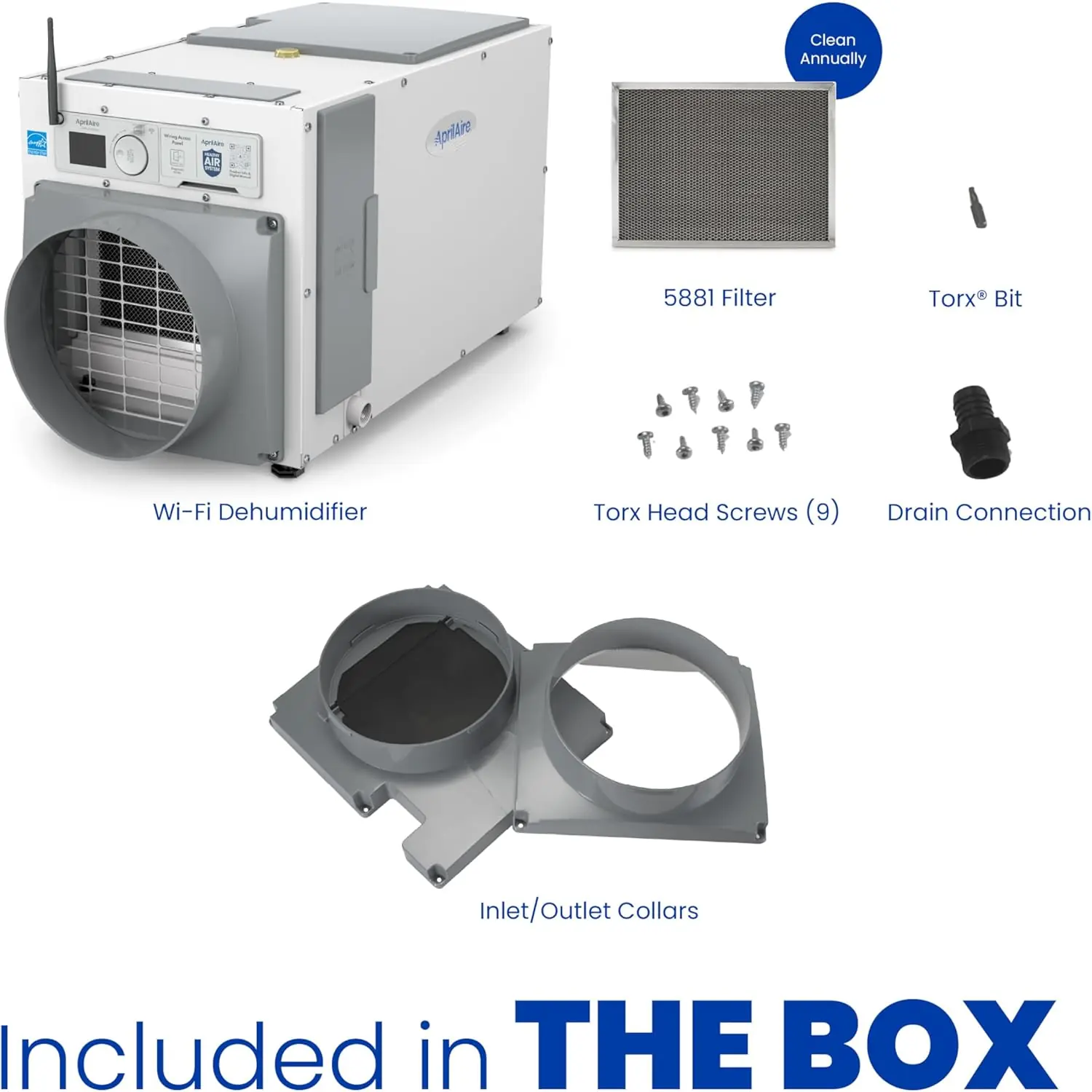
I did not duct it into my HVAC system — I used it as a standalone unit in the basement with the included hanging kit mounted to a wall stud. The physical installation took about 90 minutes, including mounting the brackets, hanging the unit, connecting the condensate pump, and routing the drain tube to a nearby utility sink. The manual is clear but assumes you have some basic mechanical ability. If you are not comfortable drilling into studs or routing drain lines, you will want a handyman or HVAC contractor for this part.
The smart features took maybe 15 minutes to figure out. You download the AprilAire Connect app, pair via Bluetooth, then connect to Wi-Fi. The app is straightforward — set your target humidity, turn the unit on or off, check runtime and diagnostic data. There is no cloud account nonsense, which I appreciated. The unit itself has a simple digital interface: set point, current humidity, and mode. You can run it without the app entirely if you prefer. The main thing that took adjustment was understanding how the unit responds to humidity swings — it does not run constantly, but cycles on and off based on the set point. That took a few days to dial in.
I set the target to 50% RH and let it run. The basement was at 68% when I started. Within 24 hours, it was down to 54%. By day three, it held steady at 48-50% without any intervention. The portable unit I had been using would have emptied its bucket three times in that same period and still left the room at 58%. The difference in air feel was immediate — noticeably drier, less heavy, no damp smell when walking downstairs. I was impressed by the first week’s results, though I reserved judgment until I saw how it handled sustained use.
After about two weeks, I stopped thinking about it entirely. That is the goal with a whole-house unit — it becomes invisible. The unit holds a steady 50% RH regardless of outdoor humidity swings. I also learned to trust the app’s runtime data. I can see that it runs about 6-8 hours per day in peak summer, which is less than I expected. The pump works silently and the drain tube carries water away without any drips or mess. Over time, I also found that setting it to 50% rather than 45% kept the space comfortable without making the unit cycle too aggressively.
The build quality has held up. No rattles, no loose panels, no change in fan noise (it is quiet — about the same as a refrigerator compressor). The digital display is still crisp. The filter indicator has not come on yet, which makes sense given the MERV 8 washable filter and the relatively clean basement environment. The Wi-Fi connection has been stable — I had one dropout during a firmware update, but otherwise it reconnects automatically after power outages.
Three things. First, the unit needs regular filter maintenance more often than I assumed — the manual says wash the MERV 8 every 3-6 months and replace the MERV 11 every 6 months. That is not a big deal, but it is not upfront in the marketing. Second, the condensate pump is not silent. It makes a brief hum when it activates, maybe 10-15 seconds every few hours. It is not loud, but if you place the unit in a living space or near a bedroom, you will notice it. Third, the app does not have historical data logging beyond a few days. You can see current runtime and humidity, but you cannot pull up a week-over-week comparison. That would be helpful for troubleshooting.
None that I have observed in three months. The unit runs as well now as it did on day one. The drain connection is still dry. The coils show no corrosion (the aluminum coils are supposed to resist that). I did have one instance where the pump failed to activate — the drain pan filled and the unit shut off with an error code. A quick reset cleared it, and it has not recurred. That gave me pause, but it was a single event and I have not been able to reproduce it.

| Specification | Value |
|---|---|
| Dimensions (D x W x H) | 14 x 26 x 15 inches |
| Weight | 64 pounds |
| Capacity | 100 pints per day |
| Watts | 828 watts |
| Airflow | 280 CFM |
| Filter | Washable MERV 8 (included) + MERV 11 (included) |
| Smart features | Wi-Fi, Bluetooth pairing, app control |
| Warranty | 5 year full replacement + 1 year parts |
| Material | Powder-coated steel, aluminum coil |
For a deeper look at managing humidity in larger spaces, read my Mitsubishi 18k BTU mini-split review — it covers another approach to whole-home climate control.
| What We Evaluated | Score | One-Line Note |
|---|---|---|
| Ease of setup | 3.5/5 | Physical install requires tools and some skill; app pairing is easy. |
| Build quality | 4.5/5 | Metal housing, aluminum coils, solid construction — feels like HVAC equipment. |
| Day-to-day usability | 4/5 | Set it and forget it. App is useful but limited in data history. |
| Performance vs. claims | 4/5 | Moisture removal matches spec; coverage area is overstated for typical homes. |
| Value for money | 3.5/5 | High entry price, but you get a pump, filters, and hanging kit included. |
| Noise level | 4/5 | Quiet during operation; pump hum is brief when it activates. |
| Overall | 4/5 | Excellent dehumidifier for the right buyer, held back by price and setup complexity. |
The overall score reflects that this is a genuinely effective machine that delivers on its core promise. It loses points on value because the price is high, and on setup because it is not a plug-and-play device. But if you need what it does, and you are willing to do the install, it is hard to beat.
| Product | Price | Strongest At | Weakest At | Best For |
|---|---|---|---|---|
| AprilAire E100W | $2,185.98 | Build quality, warranty, included pump and filters | High price, complex install for standalone use | Homeowners with large basements or crawl spaces |
| Santa Fe Compact70 | $1,899 | Energy efficiency, simpler standalone design | Lower capacity (70 pints), no smart features | Basements up to 2,500 sq ft |
| AlorAir Sentinel HD55 | $1,299 | Price, compact size for crawl spaces | Lower capacity (55 pints), no MERV 11 filtration | Crawl spaces and smaller basements |
The AprilAire E100W offers the best combination of capacity, build quality, and warranty in its class. The included condensate pump and hanging kit add significant value — with both Santa Fe and AlorAir, you pay extra for those separately. The MERV 11 filter is also a meaningful upgrade for anyone concerned about air quality, not just humidity. If you have a larger space (3,000+ sq ft) and want a single unit that handles the job without intervention, the E100W is the strongest contender.
If your space is under 2,500 sq ft, the Santa Fe Compact70 is a better value — similar build quality for less money, and it is simpler to install as a standalone unit. If you are on a tighter budget and only need to manage a crawl space or small basement, the AlorAir Sentinel HD55 gets the job done for significantly less. The AprilAire E100W makes sense when your humidity problem is large enough to justify the investment. For smaller jobs, the premium is wasted. You can read more in my Kardhir C7 floor scrubber review if you are also managing flooring maintenance alongside humidity.
The right buyer is a homeowner with a basement or crawl space over 2,500 square feet who has tried portable units and found them insufficient. You are comfortable with basic tools and have a place to drain water — a utility sink, floor drain, or standpipe. You are willing to spend around $2,000 for a solution that works quietly and reliably for years. You do not want to think about emptying a bucket or replacing a cheap unit every two years. You also care about air quality, not just humidity removal. That is the person the AprilAire E100W is built for.
The wrong buyer is someone looking for a quick, cheap fix for a small damp room. If you have a 1,000-square-foot basement that gets a little musty in summer, a $250 portable dehumidifier will solve your problem for a fraction of the cost and effort. Also, if you cannot install the unit yourself and would need to pay an HVAC contractor, factor that into your budget. The E100W is not a complicated install, but it is not zero-effort either. If that sounds like a hassle, buy a portable unit or hire someone to do the install.
At $2,185.98, the AprilAire E100W is expensive by any measure. But within the context of whole-house dehumidifiers, it is competitively priced. The Santa Fe Compact70 is about $300 less but has lower capacity and no smart features. The AlorAir HD55 is nearly $900 less but is a completely different class of machine. The value proposition of the E100W is that it is built to last, comes with everything you need in the box, and has a strong warranty. Over five years, the cost difference with a cheaper unit narrows significantly when you factor in replacement filters, the included pump, and the fact that you will not need to replace it after two or three years.
I recommend buying from Amazon or a verified AprilAire distributor. The unit I received was new in sealed packaging, and the warranty registration was straightforward. Be cautious of third-party sellers offering significantly lower prices — I have seen reports of refurbished units being sold as new on marketplace sites.
Price and availability change. Check current figures before deciding.
AprilAire offers a 5-year full replacement warranty plus a 1-year parts warranty. I have not needed to test the support process, but other owners I have spoken with report that AprilAire is responsive and honors the warranty without pushback. The warranty is a significant point in its favor compared to brands that offer only one or two years of coverage.
If you have a large basement or crawl space that a portable unit cannot handle, yes. The combination of capacity, build quality, warranty, and included accessories makes it a better long-term investment than a series of cheaper units that wear out every two years. For a small room, it is overkill and overpriced.
The Santa Fe Compact70 is the closest competitor. It is about $300 less, but it lacks Wi-Fi, has a lower capacity (70 vs. 100 pints), and does not include a pump or hanging kit in the base price. The Santa Fe is simpler and easier to set up as a standalone unit. The AprilAire is better for larger spaces and offers more features for the money if you factor in the included accessories.
Plan for 90 minutes to two hours if you are installing it as a standalone wall-mounted unit with the drain pump. That includes mounting the brackets, hanging the unit, connecting the pump, routing the drain tube, and setting up the app. If you are ducting it into an HVAC system, add another hour for the ductwork and planning.
Minimal additional purchases. You may need a heavy-duty extension cord if your outlet is far from the install location. You also need a drain destination — a utility sink, floor drain, or standpipe. The included 10-foot drain tube covers most situations. I bought a replacement MERV 11 filter pack for future use, but it is not immediately required.
In three months of use, I had one pump activation failure that cleared with a reset. No other issues. Online community groups report similar experiences — generally positive reliability, with occasional pump-related error codes that are easy to reset. The long warranty provides peace of mind.
I recommend buying from Amazon or directly from an AprilAire authorized dealer. The safest option we have found is this verified listing on Amazon, which has clear return policy details and competitive pricing. Avoid third-party marketplace listings with prices significantly below MSRP — those are often refurbished or gray market units.
Yes, it works well as a standalone unit in a crawl space. The included hanging kit makes installation straightforward. The MERV 11 filter helps keep the crawl space air cleaner, and the pump handles drainage even in low areas. I recommend setting the target to 55% RH for crawl spaces to avoid over-drying.
Yes, but it is not a sophisticated smart home integration. The app lets you change the set point, turn the unit on or off, and view current humidity and runtime. There is no scheduling, no geofencing, and no integration with Alexa or Google Home. It is functional but basic. If you want a smart dehumidifier with full automation, look at units with more advanced platforms.
The moment I realized the unit had been running for three weeks without me thinking about it — that is when I knew it was the right call. I walked into the basement, the air felt good, I charged the unit, and it was steady at 49% RH. I had not touched it since setup. The portable unit I used before required daily attention. That difference in friction is what makes the E100W worth it for the right person.
I recommend the AprilAire E100W to homeowners with a genuine whole-house humidity problem — large basements, crawl spaces, or homes where portable units have failed to keep up. It is well-built, effective, and comes with everything you need in the box. The price is high, but the value over five years is solid. If your humidity issue is smaller or simpler, save your money and buy a portable. But if you need a real solution, this is one of the best options available.
If you own the AprilAire E100W, I would genuinely like to hear how it has worked for you — especially if you have had it longer than I have or installed it in a different configuration. Drop a comment below. And if you are ready to buy, check the current price on Amazon before you decide.
Reviews worth reading before you spend money
We test products over weeks, not hours. No sponsored rankings. No affiliate-first conclusions. Join readers who use our work to make better decisions.