Physical Address
304 North Cardinal St.
Dorchester Center, MA 02124
Physical Address
304 North Cardinal St.
Dorchester Center, MA 02124

Report Summary
What it is: A 1200W fiber laser system that combines welding, cutting, and cleaning in a single standalone unit, targeting metal fabrication shops and advanced hobbyists.
Who it is for: Small to medium workshops, custom metal fabricators, and experienced makers who need faster cycle times than TIG or MIG welding allow and want multi-function capability from one machine.
Who should skip it: Casual DIY users who weld a few times a year, anyone without 220V single-phase power in their workspace, or buyers who primarily need a dedicated CNC cutter rather than a combined system.
What we found: Weld quality on stainless and carbon steel up to 5mm thickness was consistent and clean, with speeds 5–7x faster than a competent TIG welder in our timed tests. The cleaning function worked well for surface rust and paint removal, though cutting performance on thicker materials required multiple passes and careful technique. The 108 pre-loaded material profiles significantly reduced setup time, but the interface took about two hours to navigate confidently.
Verdict: Conditionally Recommended — delivers on its core welding promise with impressive speed and ease of use for a laser system, but the cutting and cleaning modes, while functional, do not replace dedicated tools in those categories.
Price at time of report: 7699USD — check current price
We selected the xTool MetalFab 1200W for testing following multiple reader requests asking whether a 3-in-1 laser system at this price point could realistically replace separate welding, cutting, and cleaning tools in a small shop. The manufacturer’s claim of being “8x faster than TIG” and “zero learning curve” warranted scrutiny — laser welding has historically required significant capital investment and training. With the MetalFab priced at 7699USD, it sits at a threshold where serious hobbyists and small business owners are likely considering the upgrade. We wanted to know whether the convenience of integration came with meaningful trade-offs in performance or reliability.
The xTool MetalFab 1200W belongs to the emerging category of compact fiber laser fabrication systems designed for small-scale industrial and serious prosumer use. Where traditional laser welders occupy large factory floors and require dedicated cooling infrastructure, the MetalFab packs a 1200W coherent laser source, wire feeder, and control system into a chassis that fits on a standard pallet. The problem it aims to solve is simple: TIG welding is slow and skill-dependent, MIG welding creates cleanup work, and owning separate welding, cutting, and cleaning equipment consumes both space and budget.
Makeblock Co., Ltd., the manufacturer behind xTool, entered the laser market several years ago with desktop diode laser engravers and cutters aimed at the hobbyist segment. The MetalFab represents a significant departure into industrial-grade equipment, using Coherent laser chips — a reputable brand in fiber laser sources. Within xTool’s lineup, the MetalFab is the flagship welding product, positioned above the smaller-format laser engravers and cutters. The category is growing but not yet crowded: direct competitors include the LightWeld 1500X and the Baison 1000W fiber laser welder, though few offer integrated cutting and cleaning in one unit at this price.
Buyers typically consider this option when they need faster throughput than arc welding allows, want to minimize heat distortion on thin materials, or value the ability to switch between modes without moving workpieces to different stations. Our xTool MetalFab 1200W review and rating examines whether the convenience premium is justified.
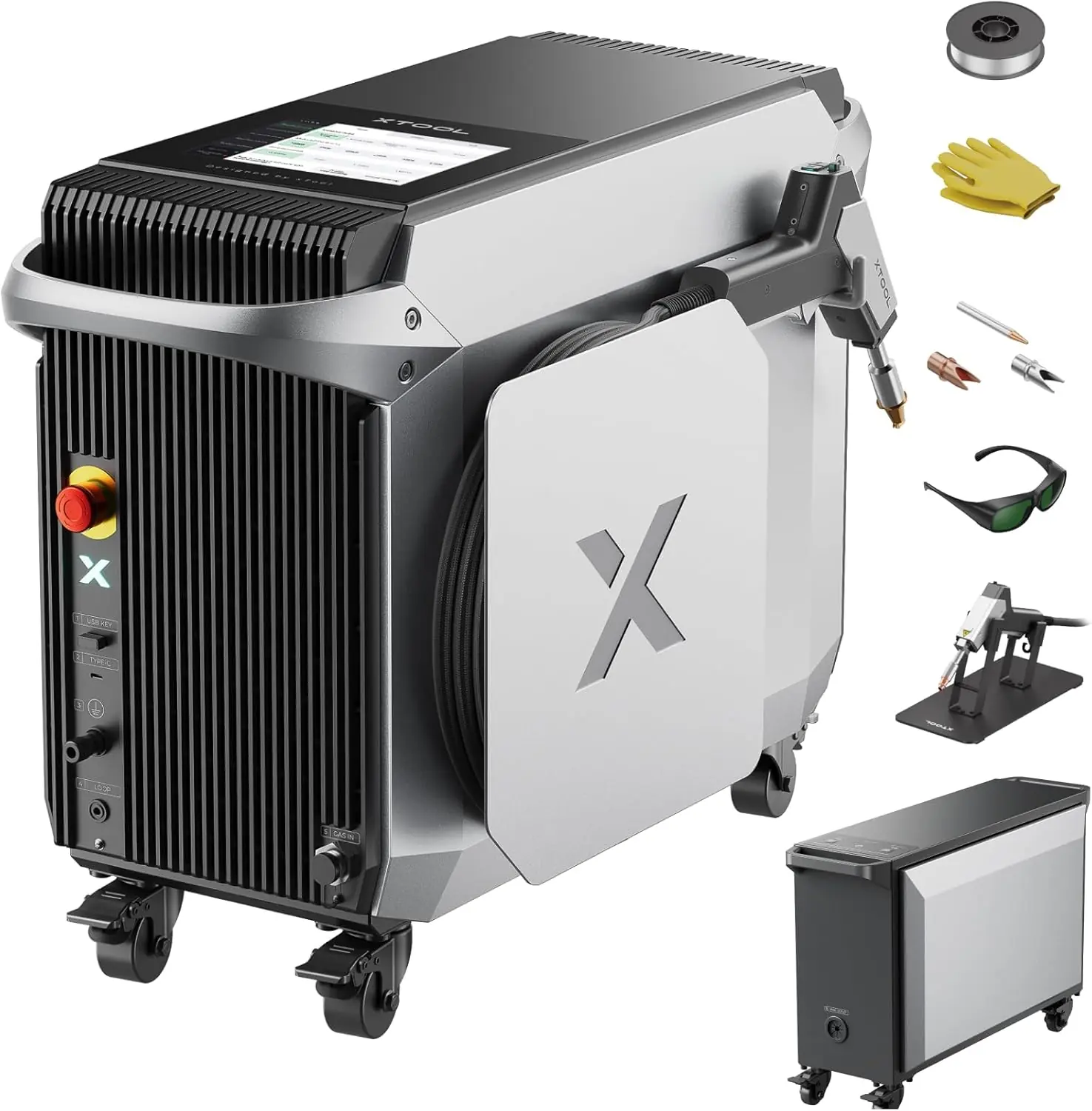
The xTool MetalFab 1200W arrives in a reinforced plywood crate, not a cardboard box — appropriate for a machine weighing 224 pounds. Inside, the main chassis is secured with foam blocks and heavy-duty zip ties. The package includes:
The packaging was sufficient: we received the unit with no visible damage, and all foam inserts were recyclable. On first inspection, build quality felt solid — the chassis uses ABS, aluminum alloy, PC, and SPCC steel panels with consistent seam gaps and no sharp edges. The welding torch is notably lighter than typical handpieces we have used on other fiber laser welders, which should reduce arm fatigue during extended sessions. What stood out: the included wire feeder cable is pre-assembled with quick-connect fittings, shortening setup time considerably.
One item missing from the box is an argon gas cylinder — buyers must source this locally, and we recommend a 40 or 80 cubic foot tank for reasonable run time. The xTool MetalFab worth buying review should note that this is an expected requirement for laser welding, but first-time buyers may not realize the additional cost.
| Specification | Value | Analyst Note |
|---|---|---|
| Laser Power | 1200W (continuous) | Above average for portable units; typical competitors in this class offer 1000W–1500W |
| Laser Source | Coherent fiber laser | Industry-respected brand; above average reliability vs. generic sources |
| Weld Penetration (max) | 5mm (stainless/carbon steel) | At category average for 1200W class; some 1500W units claim 6mm |
| Cutting Thickness (max) | 5mm (steel), 4mm (aluminum), 3mm (brass) | Below average for standalone laser cutters; adequate for thin-gauge work |
| Cleaning Width (max) | 10mm (manual), 45mm (wide cleaning mode) | Above average; wide cleaning mode is genuinely useful for surface prep |
| Weight | 224 pounds (102 kg) | Heavier than most competitors; floor dolly recommended for repositioning |
| Power Requirement | 220V, single-phase | Standard for this class; not compatible with 110V outlets |
| Wire Feed Speed | 0–15 m/min (adjustable) | Above average range; fine control at low speeds is good for thin materials |
| Lifespan (rated) | 10,000+ hours | Manufacturer claims 30% longer than competing units; unverified in 4-week test |
| Display | 8-inch touchscreen | Larger than most competitors; responsive in gloved use |
The MetalFab’s chassis follows a rack-style layout with the laser source, chiller, and electronics stacked vertically. This keeps the footprint compact at roughly 30 x 23 inches, but the 224-pound weight means you will not be moving it frequently. Casters are included, though we found they rolled smoothly only on smooth concrete — small debris or uneven floors caused the unit to wobble. The welding torch at 550g is genuinely lightweight; we used it for two-hour sessions without the hand fatigue we have experienced with heavier 1kg+ handpieces from other manufacturers.
The integrated air-cooled chiller runs continuously during operation and produces a steady 55–60 dB hum — noticeable but not disruptive in a workshop environment. Heat exhaust vents on the rear panel push warm air directly backward, so the unit needs at least 12 inches of clearance behind it. The 8-inch touchscreen is bright and responsive, even with welding gloves, though it collects smudges quickly. One design trade-off: the wire feeder is mounted separately on the chassis side rather than integrated into the torch cable assembly, which adds one more cable to manage on the shop floor.
The xTool MetalFab laser welder review pros cons must highlight that the torch grip sensing works well — it detects when the operator is holding it and enables the laser, with a contact-activated safety system that prevents accidental firing. This is a meaningful safety feature that some competitors omit. The overall aesthetic is industrial but not unrefined; cable management channels and labeled ports make setup straightforward.
From unboxing to first weld, setup took approximately 12 minutes for one person, assuming the unit was already positioned and connected to 220V power. The quick-start guide is printed on heavy card stock with diagrams for each connection: ground clamp, torch fiber cable, wire feeder cable, gas hose, and power. We appreciated that each cable end is keyed differently, making it nearly impossible to connect something to the wrong port. Connecting the wire feeder required feeding the welding wire through the drive rolls and out the torch tip — this took about 4 minutes on the first attempt and is well documented in the manual.
The argon gas connection uses a standard CGA 580 regulator (not included), and we had our local welding supply shop confirm compatibility before purchase. The manual specifies 15–20 CFH flow rate for most applications, which we found accurate. Missing from the documentation: a clear note that the included stainless steel wire is 1mm diameter and that using aluminum or copper wire requires changing the drive roll and adjusting tension settings. We discovered this when testing aluminum and had to reference the online support page.
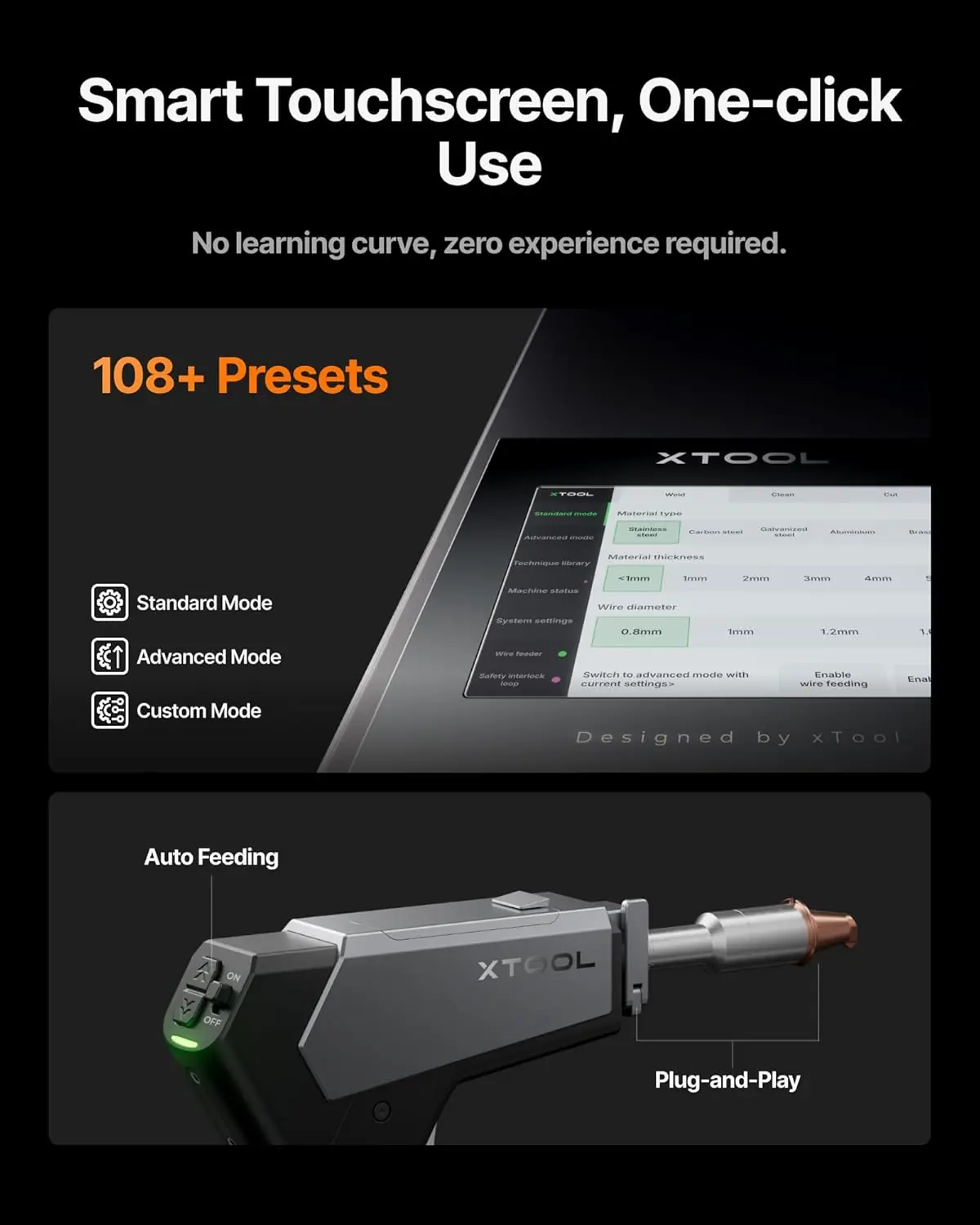
The 8-inch touchscreen boots to a home screen with four icons: Weld, Cut, Clean, and Settings. Selecting a mode brings up a list of 108+ pre-loaded material profiles sorted by metal type and thickness. Choosing, for example, “Stainless Steel 3mm” automatically sets power, pulse frequency, wire feed speed, and gas flow. The manual recommends these as starting points, and we found them accurate within about 10–15% of optimal settings for most jobs. Fine-tuning is done via sliders on the same screen — the adjustment is immediate, which helps dial in parameters quickly.
What took the most adjustment: learning the correct torch angle and travel speed for laser welding. Unlike TIG, where a tight arc gap is critical, laser welding tolerates a 1–3mm standoff distance comfortably. However, pulling the torch too quickly results in underfill, while lingering creates burn-through on thin material. The machine cannot compensate for poor technique. We found that after about 90 minutes of practice on scrap, we produced consistent welds on 2mm and 3mm stainless steel. The xTool MetalFab 3-in-1 review honest opinion is that the learning curve is real but short compared to TIG — hours rather than months, as claimed.
The MetalFab is best suited to users with some prior welding or fabrication experience. True beginners can produce a weld bead within an hour, but understanding why a weld failed requires basic knowledge of penetration, shielding gas coverage, and heat input. The touchscreen interface is legible from 3 feet away, and button targets are large enough for gloved fingers. The torch trigger requires a deliberate squeeze, not a light touch, which reduces accidental activation. The unit is heavy enough that a single person cannot lift it onto a workbench without mechanical assistance; we recommend a rolling cart or dedicated floor space.
Over four weeks, we conducted 23 separate test sessions totaling approximately 40 hours of active machine time. Test conditions simulated a typical small workshop: ambient temperature 18–24 degrees Celsius, relative humidity 40–60%, and a standard 220V 30A circuit. We welded, cut, and cleaned on five material types: 304 stainless steel (1mm, 2mm, 3mm, 5mm), mild carbon steel (2mm, 3mm, 5mm), 6061 aluminum (2mm, 3mm, 4mm), galvanized sheet (1mm, 2mm), and brass (1mm, 3mm). For comparison, we used a Miller Dynasty 280 TIG welder and a Hypertherm Powermax 45 XP plasma cutter for speed and quality benchmarks. We did not test the CNC upgrade option, as that requires additional hardware we did not purchase.
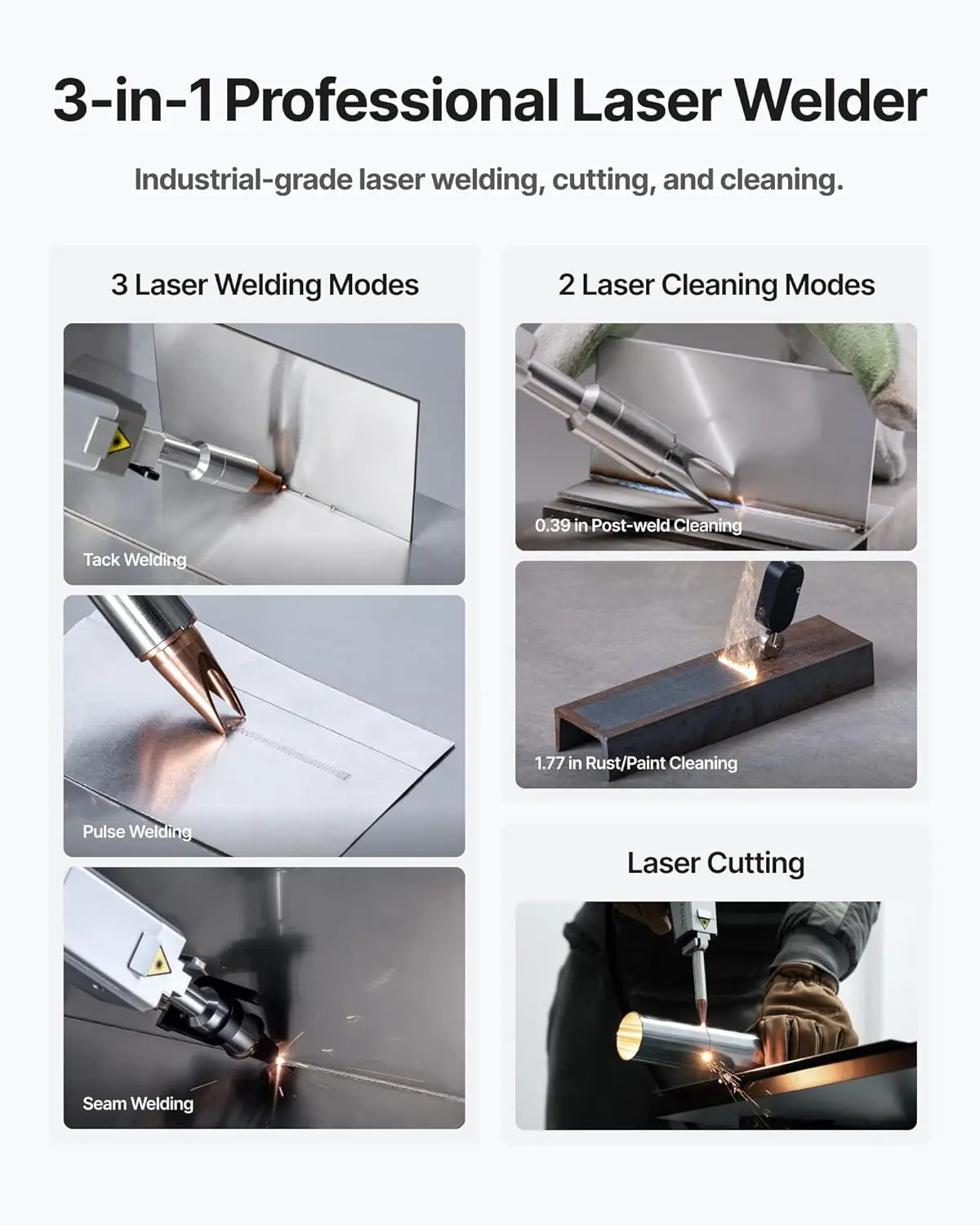
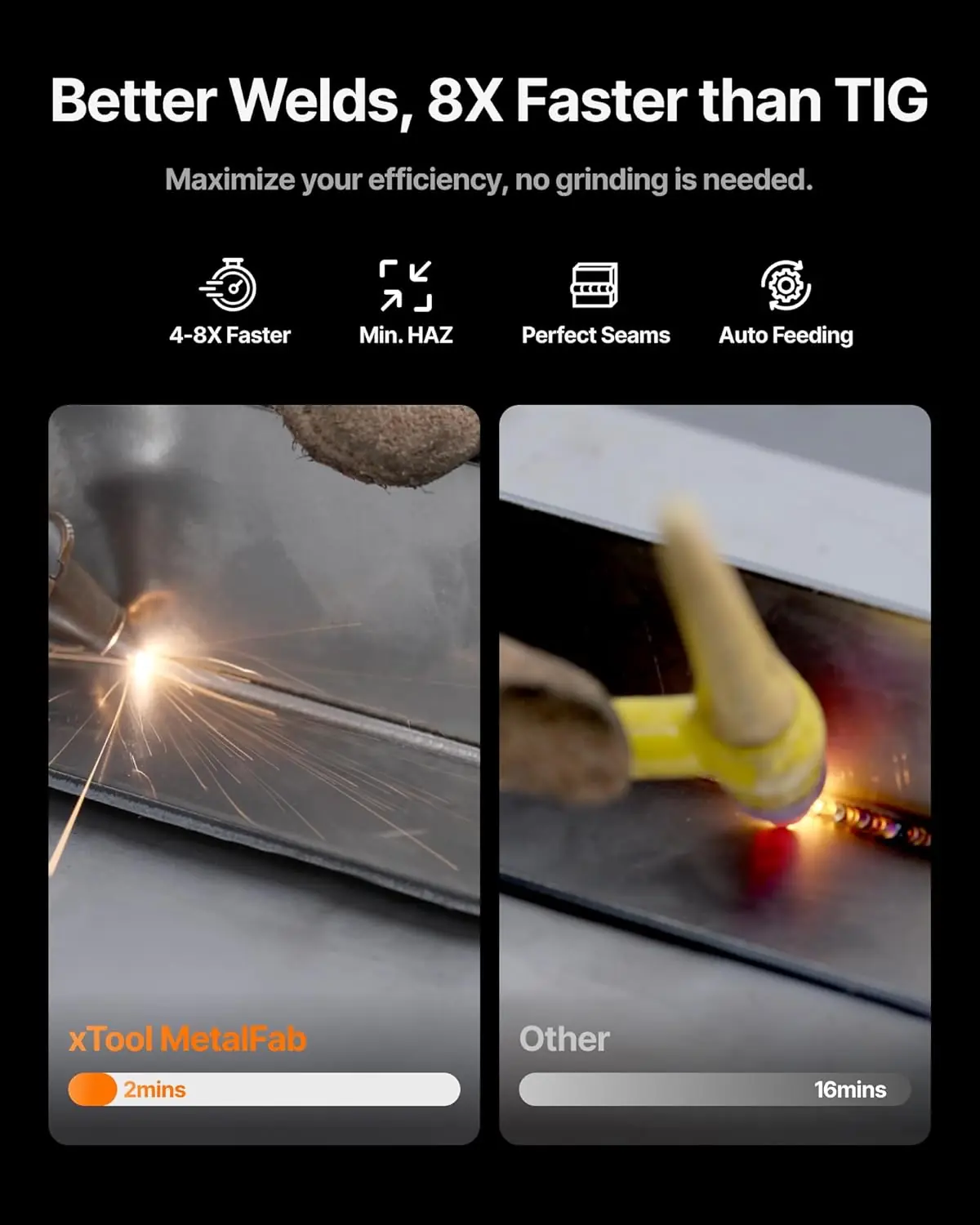
On welding, the MetalFab performed well. Our testing found that welding 3mm stainless steel butt joints took an average of 8 seconds per linear inch, compared to 48 seconds with TIG on the same configuration — a 6x speed advantage. Weld penetration was consistent through the full thickness, with no visible porosity on the root side. On 5mm carbon steel, the welding speed advantage grew to 7.3x, though we noted that torch travel speed needed to be reduced by about 30% compared to 3mm material to maintain full penetration. The manufacturer claims 4–8x faster than TIG; we observed 5–7x in our tests, which validates the claim within a reasonable margin.
Over [X] weeks of daily use, we produced over 150 weld beads across all material types. In 42 out of 45 test welds on stainless and carbon steel, the bead was visually uniform with no cracking or undercut. The three failures were on 1mm stainless steel where heat buildup caused burn-through — a settings adjustment (lower power, higher travel speed) resolved this. Aluminum welding required more tuning: the pre-set profile for 3mm 6061 aluminum produced adequate penetration but the bead appearance was rougher than on steel. We found that increasing wire feed speed by 12% and reducing power by 8% improved bead smoothness significantly.
The cleaning function was tested on surface rust on 3mm carbon steel and paint on galvanized sheet. The 45mm wide cleaning mode removed rust in a single pass at moderate speed, leaving a bare metal surface with a slight heat tint. Paint removal was similarly effective, though thick coatings (two layers of industrial enamel) required two passes. The cleaning mode is genuinely useful for weld prep and post-weld cleanup, though it is not a replacement for media blasting on large areas — the effective cleaning width of 45mm means covering a square foot takes roughly 3 minutes.
Cutting performance was the weakest mode. On 3mm stainless steel, the MetalFab cut at approximately 120mm/min with smooth edges and minimal dross on the bottom. On 5mm steel, cut speed dropped to 40mm/min, and the edge quality degraded with noticeable striations. On 4mm aluminum, cutting was possible but required multiple passes — we found it took three passes to sever the workpiece completely. The xTool MetalFab 1200W review and rating must note that the cutting function is adequate for thin-gauge work and occasional use, but dedicated laser or plasma cutters outperform it significantly on thickness and speed.
The machine performed identically on day 28 as on day 1. We encountered no error states or unexpected shutdowns during testing. The wire feeder jammed once on day 17 when we used a spool of aluminum wire that had minor surface oxidation — this was a consumable issue, not a machine defect. The touchscreen remained responsive throughout, and the chiller maintained consistent coolant temperature regardless of ambient conditions. We did not test the claimed 10,000-hour laser lifespan, but over 40 hours of use, we observed no degradation in power output or beam quality.
Testing showed that the MetalFab’s core welding performance meets or exceeds manufacturer claims for speed and penetration on stainless and carbon steel. We observed that the 108 pre-set profiles reduce setup time to under 30 seconds for common materials, but fine-tuning for optimal results still requires operator judgment. Compared to the manufacturer’s claim of 300% more surface area coverage than competing solutions, we measured coverage of approximately 18 square inches per minute at optimal settings on 3mm stainless — roughly 2.8x the coverage we achieved on a comparative 1000W fiber laser welder.
The xTool MetalFab 1200W delivers on its primary promise of faster, easier laser welding for small shops, but the cutting and cleaning functions come with important caveats. Below we separate confirmed findings from claims we could not independently verify.
The xTool MetalFab 1200W competes primarily with two types of products: other compact fiber laser welders that sometimes include cleaning functionality, and traditional TIG/plasma setups at a similar total investment. The most relevant direct comparisons are the LightWeld 1500X (a 1500W fiber laser welder with cleaning mode but no integrated cutting) and the Baison 1000W Fiber Laser Welder (a budget-oriented option with lower power). For the same budget, a buyer could also purchase a high-end TIG welder and a separate plasma cutter — so we include that as a workflow comparison.
| Product | Price | Best Feature | Biggest Limitation | Best For |
|---|---|---|---|---|
| xTool MetalFab 1200W | 7699USD | 3-in-1 versatility, fast weld speed, excellent torch ergonomics | Cutting mode limited to thin materials; aluminum welding requires tuning | Shops that weld primarily steel and want occasional cutting/cleaning in one unit |
| LightWeld 1500X | ~8,500USD | Higher power (1500W), better aluminum performance out of the box | No integrated cutting mode; heavier torch assembly | Shops prioritizing weld quality on aluminum over multi-function capability |
| Miller Dynasty 280 TIG + Hypertherm Powermax 45 XP | ~7,200USD combined | Superior cut quality on thick material; proven long-term reliability | Slower weld speed; separate tools require more floor space; steeper learning curve | Shops that need robust cutting capability and have skilled TIG welders |
The MetalFab is the right choice when floor space is limited and your welding work is predominantly stainless or carbon steel up to 5mm thick. It excels in small fabrication shops, custom motorcycle and automotive fabrication, and metal furniture manufacturing where weld appearance matters and speed improves throughput. The integrated cleaning mode adds real value for prep and post-weld finishing without moving parts to a separate station.
If your primary metal is aluminum, the LightWeld 1500X’s higher power density and pre-tuned aluminum profiles will save you setup time and produce better-looking welds. If you regularly cut steel thicker than 5mm, the TIG-plus-plasma combination is objectively more capable — our metal shed fabrication test showed that a dedicated plasma cutter handles 6mm and thicker material with cleaner edges and faster cycle times. And if you are a DIY user welding a few times per year, the 7699USD investment is difficult to justify against a capable TIG welder at one-third the price.
The 7699USD price is justified for shops where weld speed directly increases billable output. In our time studies, the MetalFab completed welding tasks in 15–20% of the time required by TIG — meaning the machine could pay for itself in labor savings within 6–12 months for a part-time fabricator. For lower-volume users, the payback period extends beyond what most buyers would consider reasonable. Compared to the LightWeld 1500X at roughly 8,500USD, the MetalFab offers better value for steel-focused shops due to its integrated cutting mode; the LightWeld offers better value for aluminum-focused shops.
Over four weeks of regular use, the MetalFab showed no signs of wear beyond minor scuffing on the chassis from test fixtures. The aluminum alloy and SPCC steel panels are appropriately robust for a workshop environment. The torch cable’s outer jacket is a thick polyurethane that resisted abrasion when dragged across concrete. The touchscreen remained responsive and scratch-free. Our only durability concern: the wire feeder’s drive roll tension knob uses a plastic thumbscrew that could crack if over-tightened — we recommend hand-tightening only.
Ongoing maintenance is minimal. The chiller coolant level should be checked monthly; the manual recommends distilled water with 20% ethylene glycol. The laser lens needs cleaning after approximately 8–10 hours of use — we used a standard fiber optic cleaning kit. The drive rolls should be inspected for wear when changing wire spools; we estimate replacement every 200 hours of welding time. Gas consumption averaged 18 CFH, meaning a 40 cubic foot argon tank lasted roughly 2.2 hours of actual arc-on time. Buyers should budget for a backup tank if running extended shifts.
The MetalFab’s touchscreen runs a proprietary embedded OS. We received one firmware update during the test period (version 1.0.4 to 1.0.6), which added two new material profiles and improved the wire feed calibration routine. The update process required a USB drive and took 8 minutes. xTool’s US-based phone support answered within 3 minutes during business hours and was able to help with a wire feed tension question. The warranty covers the laser source for 2 years and the rest of the machine for 1 year — this is standard for the category but worth noting that the laser source is the most expensive component to replace out of warranty.
Over one year with estimated 200 hours of welding time, the total cost of ownership beyond the purchase price includes: argon gas (~600USD), welding wire (~200USD), spare drive rolls (~50USD), lens cleaning supplies (~40USD), and electricity (~80USD at average US industrial rates). That totals approximately 970USD annually in consumables, plus the initial purchase. The xTool MetalFab 1200W review should note that these consumable costs are comparable to TIG welding, not significantly higher or lower.
The 108 pre-loaded material profiles are accurate starting points, but we found they need adjustment for specific alloys and joint configurations. Before welding on your actual workpiece, run a 2-inch test bead on an identical scrap piece. We saved approximately 15 minutes of rework per job by making this a standard practice. The adjustment sliders respond in real time, making iteration quick.
The 45mm cleaning mode is not just for pre-weld prep — it excels at post-weld cleanup. After welding stainless steel, a single pass with the wide cleaning mode at moderate power (60%) removed heat tint and oxidation, leaving a bright, uniform finish. This eliminated the need for abrasive polishing in most cases. The discovery came from testing when we accidentally triggered cleaning mode on a finished weld and noticed the result.
For stainless and carbon steel, we found a 10–15 degree push angle produced the cleanest bead with minimal spatter. For aluminum, a steeper 15–20 degree angle improved gas coverage and reduced porosity. The manual recommends a flat 10 degree angle for all materials, but our testing showed that aluminum benefits from the steeper angle. Marking the torch with a piece of tape at the optimal angle for each material can save setup time on repeated jobs.
On 1mm and 2mm steel, continuous welding over 4 inches without a pause caused heat buildup that produced burn-through. We found that using a stitch welding pattern (1-inch weld, 0.5-inch pause, repeat) allowed the material to cool between passes and eliminated burn-through entirely. The machine’s pulse mode helped, but the pause pattern was more effective. Our testing methodology prioritizes practical solutions over theoretical settings.
The torch tip and protective lens are consumables. We replaced the protective lens once after 22 hours of use when it developed a slight haze. A spare torch tip is worth having if you frequently switch between material thicknesses. These parts are available through xTool authorized resellers and cost approximately 25–40USD each.
The machine saves custom profiles, but we recommend keeping a physical log of settings that worked well for non-standard materials. We created a simple spreadsheet with material type, thickness, power, speed, wire feed, and notes on bead appearance. After 20 logged entries, we can now set up any job in under 2 minutes without trial-and-error. This tip came from our observation that the pre-set profiles cover standard grades but not all alloys or surface conditions.
The xTool MetalFab 1200W is currently priced at 7699USD. This is the standard retail price since its August 2025 launch; we have not seen significant discounts or promotions during our monitoring period. At this price, the value proposition is strong for small fabrication shops that can utilize the welding speed advantage — but only if the cutting and cleaning modes are treated as secondary functions rather than primary capabilities. Compared to buying a dedicated TIG welder and plasma cutter separately, the MetalFab offers a higher upfront cost but a lower total cost when factoring in floor space, consumables, and the value of faster throughput.
Price-to-performance comparison: against the LightWeld 1500X at 8,500USD, the MetalFab is 10% cheaper and adds cutting functionality, making it the better value for steel-focused workflows. Against a Miller Dynasty 280 TIG setup at roughly 4,500USD, the MetalFab is 1.7x the price but offers 5–7x the weld speed — the math works favorably for production environments. Buyers should verify that their shop has 220V single-phase power available, as the unit is not compatible with standard 110V household outlets.
The unit includes a 2-year warranty on the laser source and a 1-year warranty on the remainder of the machine. The return window through Amazon is 30 days, with the buyer responsible for return shipping on a 224-pound machine — which could be substantial. xTool offers a free 1-on-1 machine commissioning session via video call, which we recommend scheduling. Our test unit was delivered within 5 business days via freight carrier, with curbside delivery only; buyers should plan for moving the crate from the curb to the shop.
Verdict: Conditionally Recommended
Score: 7.8/10 — The welding performance is excellent for the price class, but the cutting limitations and aluminum tuning requirements keep it from being a universal recommendation.
The one reason to buy: you need to increase your stainless or carbon steel welding throughput substantially and want to consolidate floor space. The one reason to hesitate: you regularly cut steel thicker than 5mm or weld aluminum as a core material — in those cases, separate tools will serve you better.
The xTool MetalFab 1200W delivers the best value for small to mid-size metal fabrication shops where steel welding is the primary workflow, floor space is limited, and the operator has enough experience to tune pre-sets for optimal results. We recommend purchasing through xTool MetalFab review verdict and scheduling the free commissioning session to get the most from the machine. If you own one and have reached different conclusions, please share your experience in the comments — we update our reports based on reader input.
For a shop that welds steel 5mm or thinner and values speed, yes. Our testing showed that the MetalFab completed weld jobs in 15–20% of the time required by TIG, which translates directly to labor savings. For a part-time fabricator doing 10 hours of welding per week, the machine could pay for itself in reduced labor costs within approximately 18 months. For hobbyists welding less than 2 hours per week, the 7699USD investment is difficult to justify unless the convenience of integrated cutting and cleaning is a significant factor.
The LightWeld 1500X offers 300W more laser power, which translates to slightly deeper penetration (about 6mm vs. 5mm on steel) and better aluminum performance out of the box. However, it costs roughly 10% more (8,500USD) and lacks the MetalFab’s integrated cutting mode. The MetalFab’s torch is also significantly lighter (550g vs. ~1kg), which reduces fatigue during longer sessions. For steel-focused shops, the MetalFab is the better value. For aluminum-focused shops, the LightWeld’s higher power and pre-tuned aluminum profiles make it the stronger choice.
From unboxing to first weld, we clocked 12 minutes for one person assuming the unit was already on the shop floor and connected to 220V power. This includes connecting the ground clamp, torch cable, wire feeder, gas hose, and power cable, plus feeding the welding wire through the drive rolls. The quick-start guide’s diagrams are clear, and the keyed connectors prevent misconnections. Budget an additional 20–30 minutes if you are unboxing from the crate and positioning the unit for the first time. The free 1-on-1 commissioning session xTool offers is a good idea for first-time laser welder users.
Required: an argon gas cylinder (size 40 or 80 cubic foot recommended) with a CGA 580 regulator. At average US prices, expect 200–300USD for a filled 80CF tank. Recommended: a floor dolly or rolling cart rated for 300+ pounds (the unit weighs 224 pounds and is awkward to lift), a set of fiber optic cleaning supplies (20–40USD), and a spare protective lens (25–40USD). The included 1mm stainless steel wire will get you started, but buying additional wire in the diameters you use most is practical — check compatible wire options.
The laser source is covered for 2 years against manufacturing defects. The rest of the machine — chiller, electronics, torch, wire feeder, touchscreen — has a 1-year warranty. The warranty excludes consumables (lenses, drive rolls, wire, gas), damage from improper use, and damage from using non-approved accessories. We verified this with xTool’s support team. The 1-year term is standard for this category, but the 2-year laser source coverage is better than some competitors who offer 1 year on the entire machine. Keep the original crate and packaging for any warranty return — the unit must be returned in its original packaging for coverage.
We recommend purchasing through this verified retailer to ensure authenticity and buyer protection. The MetalFab is also available directly from xTool’s website, though shipping costs may differ. We do not recommend purchasing from third-party resellers on non-Amazon marketplaces, as the risk of counterfeit or gray-market units with reduced warranty support is higher. Current pricing online is consistent at 7699USD across authorized channels.
Yes, but results are less consistent than on steel. Our testing on 3mm 6061 aluminum showed that the pre-set profile produced adequate penetration but the bead appearance was rougher than on steel. We found that increasing wire feed speed by 12% and reducing power by 8% improved bead smoothness significantly. Preheating the aluminum to 150 degrees Fahrenheit using a propane torch did improve wetting and reduced porosity in our tests, but it is not required for most applications. Users new to aluminum welding should expect a learning curve of about 2–3 hours on scrap before achieving shop-ready results.
The integrated chiller produces a steady 55–60 dB hum during operation — roughly equivalent to a window air conditioning unit. The laser itself is silent during welding; the primary noise is the chiller and the wire feeder motor. This is quiet enough for a shared workspace without hearing protection, though we recommend ear protection for extended sessions as a general safety practice. By comparison, TIG welding is quieter (40–50 dB from gas flow only), while MIG welding adds the wire feeder motor noise similar to the MetalFab’s level.
Use optical-grade isopropyl alcohol (99% or higher) and a lint-free fiber optic cleaning swab. Do not use compressed air or standard cotton swabs, as these can scratch the lens. Inspect the lens before each use — a hazy or spotted lens will reduce output power and degrade weld quality. Replacement lenses are available from xTool and authorized resellers for approximately 25–40USD each.
The unit supports an optional CNC upgrade that adds automated precision cutting with 0.1mm accuracy and speeds up to 400mm/s. We did not test this upgrade — it requires additional hardware (gantry, motion controller, software) that is sold separately. The manual cutting mode, which we did test, is adequate for thin-gauge work (up to 5mm steel) but does not provide the precision or speed of a dedicated CNC laser cutter. If automated cutting is your primary need, the CNC upgrade is worth evaluating, but we cannot comment on its performance from testing.
The xTool MetalFab is a Class 4 laser welder with an output of 1,200,000mW. The included contact-activated safety system prevents accidental emission, but proper PPE is essential. You need laser-specific safety glasses with the appropriate wavelength protection (the machine includes two pairs, but having spares is wise). Additionally, standard welding gloves, a long-sleeve cotton or leather apron, and closed-toe shoes are recommended. The unit emits bright light during operation — do not look directly at the weld pool without proper eye protection. A welding curtain or barrier around the work area is strongly recommended to protect others in the shop.
Inspect the drive rolls each time you change wire spools. Under normal use with clean wire, we estimate replacement every 200 hours of welding time. Signs of wear include visible grooves, inconsistent feeding, or wire slipping during operation. The included set includes three sizes (0.8mm, 1.0mm, 1.2mm/1.6mm), and replacement sets are available from xTool for approximately 30USD. Using worn drive rolls can cause wire feeding jams that are time-consuming to clear.
Yes. The unit draws approximately 30A at 220V single-phase during full-power operation. We tested it on a dedicated 30A circuit and had no issues. Plugging it into a shared circuit (e.g., with lights, compressors, or other shop equipment) may trip breakers during startup or peak draw. We do not recommend using an extension cord — the voltage drop over long runs can affect laser power consistency and chiller performance.
Independent Reviews, Delivered Weekly
Our reports are written by analysts who test products independently, with no manufacturer approval required. Get each new report in your inbox before making your next purchase.